Every pastor knows the feeling. It's Monday, or maybe it's already Thursday, and you're staring at a blank document with a text picked and nothing else. You know a sermon has to exist by Sunday. You don't know how to get from here to there.
A sermon preparation process fixes that. Not because it makes preaching mechanical, and not because you're locked into it for life. You can change it, skip a step some weeks, add one later. But having a process means you always know what to do next, rather than starting over from scratch every single week.
Here's the one I've developed over the years. Seven steps, in order, from picking a text to checking your own heart before you preach it.
Step 1: Determine the text
Decide on your main passage and any supporting scripture before you do anything else. If you're in a series, this might already be set. If you're not, this is the one decision everything else depends on, so make it deliberately and then leave it alone.
Step 2: Reflect before you study
Before you open a single commentary, sit with the text itself.
- Read it two or three times.
- Pray over it.
- Write it out by hand. This sounds old-fashioned, and it is, but slowing down enough to copy a passage word for word surfaces things a quick read never will.
- Note what sticks out. Repeated words, odd phrases, anything that catches.
- Write down what you don't understand yet. That list becomes your study agenda for the next step.
This step exists to protect your own first impression of the text before anyone else's opinion gets in the way. You'll also notice AI isn't part of this process! One of the key aspects of preaching that is often overlooked is its formational value on the pastor themselves!
Step 3: Observe context and interpretation
Now ask the questions that establish what the passage actually meant before you ask what it means for Sunday.
Context:
- Who wrote it, and who was it written to?
- When, and why?
- What did it mean to the people who first heard it?
- How does it fit the bigger story of the book it's in?
Interpretation:
- What's the timeless truth underneath the historical detail?
- What does that truth look like today?
- Where is Jesus in this text?
- What's the one big idea this sermon needs to land?
That last question matters more than it looks. If you can't say your big idea in a sentence, you're not ready for the next step.
Step 4: Do the formal study, but not too much of it
This is where a lot of prep goes sideways, not from too little study but from too much of the wrong kind. Reading six commentaries doesn't make a sermon six times better. It usually just means you never get to the outline.
Pick one or two commentaries you trust and actually know well, rather than collecting opinions from everywhere. A solid academic commentary for the technical questions, and something like the NIV Application Commentary for the "so what" bridge to today, will cover most passages.
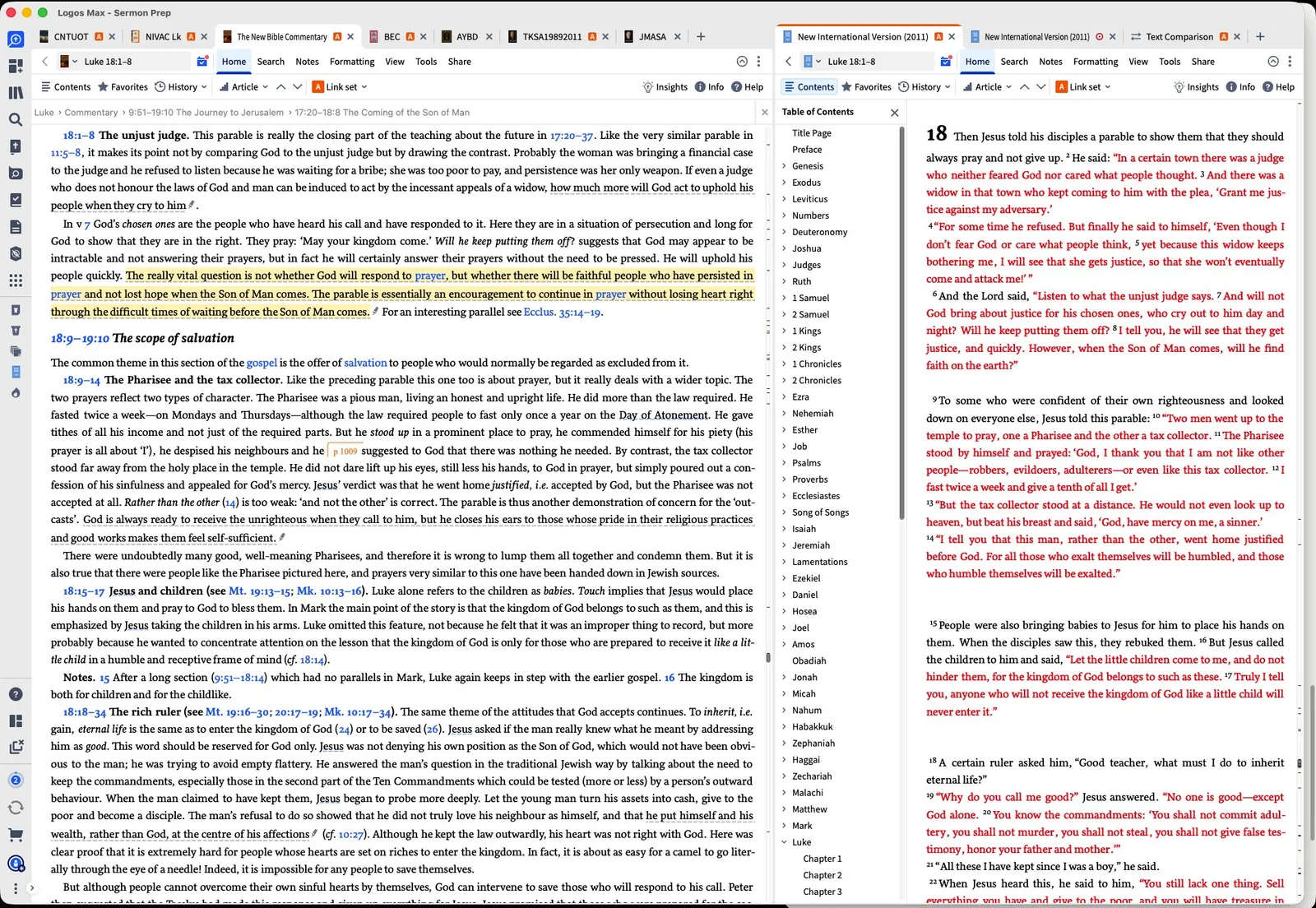
I do almost all of this study inside Logos. I save a preset called "sermon prep" and all of my preferred resources are linked with the passage that I'm preaching on. Here's a screenshot:
Step 5: Outline
With the study done, build the shape of the sermon. I use five movements ripped right off Andy Stanley.
Intro. Keep it light and short. Grab attention, then get out of the way. Don't spend more than 5% of your sermon in your intro.
Tension. Show how this affects everyone in the room, including you. Find the common ground: the confusion, the struggle, the question people already have. A statistic or the honest opposing view can help here. The job of this section is to answer one question: why does anyone need to know this? This shouldn't be more than 10% of your sermon. I'm always tempted to draw this out longer, but it leaves too little room for the more important upcoming sections: Bible, Application, and Landing.
Bible. Share the passage, the context, and what it's actually saying. This is where your step-three observations earn their keep. The question here is: what do we need to know?
Application. Get specific. Think about the actual people in front of you, and think about anyone in the room who doesn't believe any of this yet. This is often the best place for a story. The question: what do they need to do?
Landing. Help people picture a better future, for themselves or for the world around them, if they actually do what you just asked. If you haven't found Jesus in the text yet, this is your last chance. The question: why do they need to do it?
Step 6: Write
Take the outline and actually write the sermon, in a document built for writing, not for delivering. This is a different task from outlining and deserves its own space and its own draft.
Once it's written, though, you're preaching from a screen or a page on Sunday, not a Word document with a cursor blinking in it. That's a separate problem, and it's the one Preach Now exists to solve. Write it in an editor, then step into preach mode with the type, layout and lighting set the way you actually want to read from, with no toolbar in the way. If you've never tried preaching from something built for the stand instead of the desk, it's worth 14 days to find out.
Step 7: Ask yourself five questions
Before you preach it, sit with these:
- Fear. Am I more worried about what people think of this message than what God thinks of it?
- Love. Do I genuinely love the people I'm about to preach to, and is this message loving?
- Accuracy. Is there anything in here that isn't correct?
- Integrity. Am I applying this to my own life first?
- Humility. Is there anything here that draws attention to me instead of God?
None of this has to be your process exactly. But having some process, one you can run every week without reinventing it, is the difference between dreading Monday and just getting started.